
Seventy-nine millionths of a second. That's how long a latency arbitrage race lasts, contested by about six firms with exchange co location and custom hardware. A retail order takes milliseconds to arrive, a gap of roughly three orders of magnitude, and the firms that built this gap benefit from retail traders believing their rule based bots are a slower version of the same game. They're not. The real question isn't whether retail can close that gap. It's what edge actually survives once everyone admits the speed race was never winnable to begin with.
Retail traders keep calling their rule based bots algorithmic trading and lumping it in with high frequency trading, as if the two sit on the same spectrum at different speeds. One is a proprietary firm with exchange co location and custom hardware competing in microseconds. The other is a person testing a rule on historical bars and letting a broker execute it minutes or hours later. The institutions running the first game benefit from the confusion between the two, because it keeps retail traders chasing a speed race they were never entered into, instead of looking at the structural edges actually available to them. Here's exactly where that line sits.
Separating High Frequency Trading From Retail Algo Trading
The Speed Gap: HFT vs Retail Order Execution
|
HFT Latency Arbitrage Race
79
millionths of a second
Contested by about 6 firms with exchange co location and custom hardware
|
Retail Order Arrival
~1 to several
milliseconds
Routed through a standard broker, no co location or direct venue access
|
Source: Source: Article estimates on latency arbitrage race duration and retail order execution time
Most retail traders assume high frequency trading just means fast computer trading. Not wrong, exactly. But that answer misses the part that actually matters: who gets to play.
The figures tell a narrower story. High frequency trading is a firm level business. It requires regulatory registration, direct venue connectivity, and physical proximity to exchange matching engines, the kind of proximity measured in meters of fiber cable or the placement of a microwave tower. Firms in this category hold positions for seconds or less. Their entire economic model depends on winning races decided in millionths of a second, and losing most of them gracefully enough to still profit on the ones they win. Nobody joins this business by buying a faster laptop or a premium data feed. You get in, if at all, by getting hired at one of the small number of firms that already hold the infrastructure, the exchange relationships, and the capital to run it.
Retail algorithmic trading is something else entirely. A person encodes a rule, maybe a moving average crossover or a volatility breakout, tests it against historical price bars, and lets software route the resulting orders through a standard broker. Execution happens over minutes, hours, or weeks, not millionths of a second. The two activities share the word "algorithmic" and almost nothing else. One is infrastructure arbitrage conducted at the physical limits of light speed. The other is a hypothesis about price behavior, back tested and automated. Five to ten millionths of a second versus several milliseconds works out to roughly three orders of magnitude.
That speed gap is the most visible meeting point between retail orders and high frequency firms, but it's not the only one. There's a cost retail traders pay on every single order, whether or not they ever think about speed at all.
Pricing The Spread Retail Traders Already Pay
HFT vs Retail Algo Trading: Structural Differences
| Dimension | High Frequency Trading | Retail Algo Trading |
|---|---|---|
| Who can enter | Registered firms only, hired into existing infrastructure | Any individual with a broker account |
| Execution speed | 5 to 10 millionths of a second | Minutes, hours, or weeks |
| Holding period | Seconds or less | Days to weeks typically |
| Infrastructure needed | Exchange co location, custom hardware, direct venue connectivity | Standard broker platform and historical price data |
| Core strategy basis | Infrastructure arbitrage at physical speed limits | Back tested hypothesis about price behavior |
Source: Source: Article description of high frequency trading versus retail algorithmic trading characteristics
Most traders treat the bid ask spread as a flat transaction cost, a toll charged by the market maker for providing liquidity, unrelated to high frequency trading unless you're the one doing it. The figures tell a more specific story.
When a retail market order gets filled, a market maker usually matches it, either directly on an exchange or through a broker's order routing arrangement, often one that pays the broker for that order flow. That market maker's spread isn't an arbitrary number. Part of it reflects the cost of latency races the market maker wins and loses against other high speed participants, all day, every trading session. Research measuring this component has put the latency arbitrage portion at around half a basis point, a figure that sounds negligible until you reframe it: that half basis point tends to account for roughly a third of the entire effective spread the retail trader pays.
This is the second meeting point between retail orders and high frequency firms, and retail traders can't opt out of it just by trading less frequently or holding positions longer. The spread embeds the cost of a race the retail trader isn't in, can't see, and never agreed to fund. The order fills, the trade confirms, the account shows a clean execution. What doesn't show up on that confirmation is the roughly one third of the spread that exists because a market maker needed to protect itself from faster competitors before it would quote a price at all.
Both meeting points, the speed gap and the embedded spread cost, point to the same question: is there any version of this race retail can actually enter, given enough capital or the right tools? Let's check.
Checking Whether Retail Traders Can Close The Speed Gap
The pitch, often made by platforms selling faster execution or premium data feeds, is that enough capital and the right tools let an individual trader compete on speed. Can a retail trader actually do high frequency trading in any sense that matters?
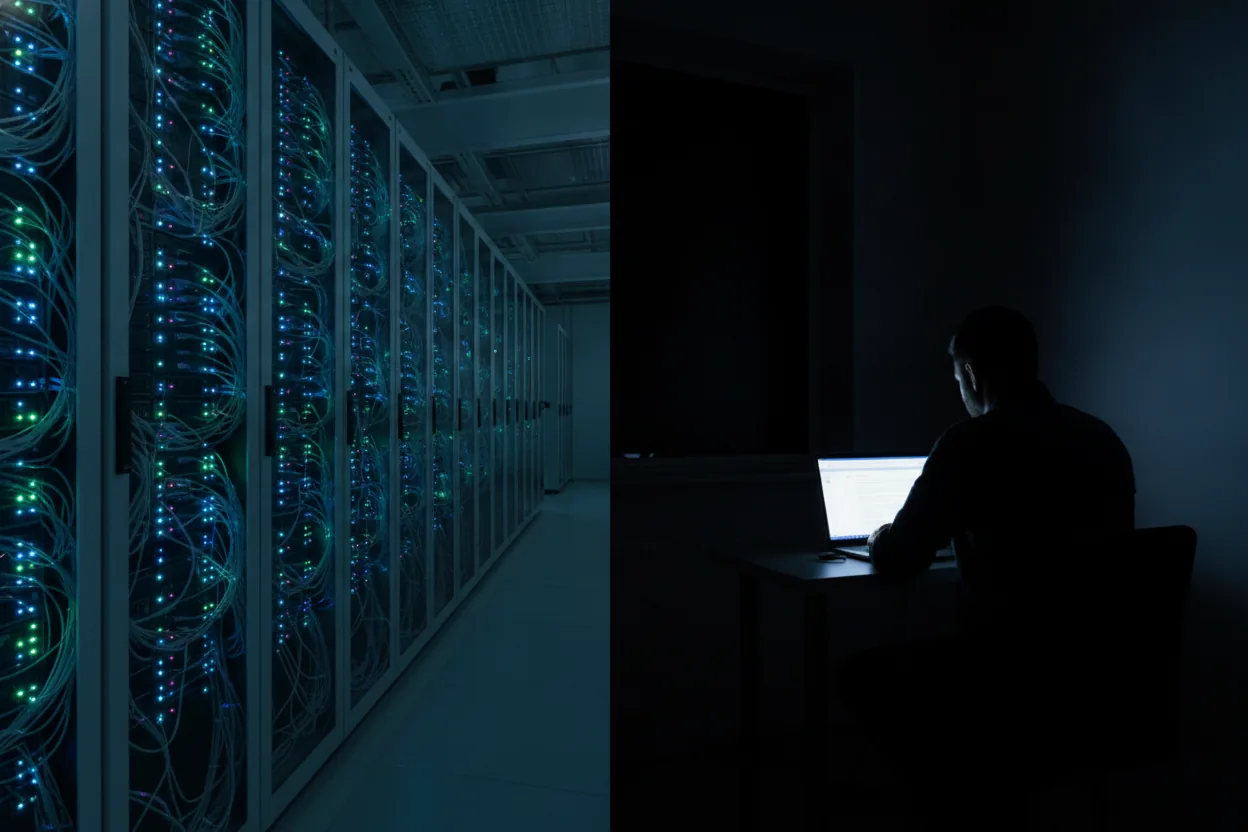
No. The research on exchange message data is specific about this: latency arbitrage races last five to ten millionths of a second, typically contested by about six firms at a time, firms that have already paid for co location at the exchange's data center, built custom network hardware, and in some cases leased microwave links between financial hubs because microwave transmission beats fiber optic cable over certain distances. A retail order, routed through a standard broker, reaches the venue in milliseconds. Milliseconds versus millionths of a second isn't a gap you close by paying for a faster internet connection or a slightly better order routing plan. It's a different category of infrastructure, built around regulatory registration and exchange level connectivity that individual accounts simply aren't structured to hold.
This matters for how retail traders think about their own tools. A rule based bot that executes in two hundred milliseconds isn't a slower version of a high frequency strategy. It operates in a different part of the market's timeline altogether. The six firms racing each other in microseconds aren't competing with the retail algo trader at all. They're competing with each other, extracting a thin and consistent edge from being marginally faster than the next co located firm, and some of that edge gets passed along as the latency component embedded in the spread. The retail trader's actual competition is other retail traders, other medium frequency strategies, and the broader pull of market direction and volatility. No amount of capital at the retail account level changes which business that account is in.
If speed is closed off this completely, the next question is whether retail algorithmic trading has any structural edge left, or whether it's just slower trading dressed up with extra steps.
Finding Where Retail Edge Actually Lives
Common wisdom says that if speed is off the table, retail algorithmic trading has no structural edge at all, that it's just slower trading with a false sense of system behind it. The figures point somewhere else: toward what high frequency firms simply aren't built to do.
High frequency strategies hold positions for seconds or less, which means they're structurally indifferent to anything that plays out over days or weeks: earnings drift, sector rotation, the slow repricing of an asset after a macro data release. These aren't latency problems. They're patience problems, and exchange co location does nothing to solve a patience problem. A retail trader encoding a rule around one of these slower moving patterns isn't racing anyone in microseconds. They're testing a hypothesis about behavior that unfolds over a timeframe no six firm latency race ever touches.
Here's what retail algorithmic trading can actually control, versus what it can't. Winning a latency race measured in millionths of a second is blocked outright by a structural infrastructure gap, and so is avoiding the latency arbitrage cost embedded in the bid ask spread, roughly a third of the effective spread on many trades. What's actually left to work with: position sizing, rule discipline, which specific inefficiencies get targeted, and the ability to test a strategy against years of historical bars before risking a dollar of real capital.
The first two sit outside retail reach entirely. The last two are the real lever. High frequency firms don't get to backtest a five microsecond decision against ten years of tick data before making it live, not the way a retail trader can sit with a strategy for months before deploying real money. Speed is their entire edge, and speed leaves no room for reflection. Retail algorithmic trading gives up speed and gains the ability to think slowly, test extensively, and act on timeframes where microsecond infrastructure gives nobody an advantage.
So here's the answer: retail can't win the speed race, and doesn't need to. The edge that survives once speed is off the table is the capacity to study slower moving patterns in depth and act on them deliberately, something no six firm microsecond race can touch. The work that's left isn't getting faster. It's figuring out which of those slower moving patterns are worth the effort to test, and that depends entirely on what a given trader is actually positioned to study.
This article is for informational and educational purposes only and does not constitute financial, investment, or legal advice. The views expressed are analytical observations and should not be relied upon for personal financial decisions. Always consult a qualified financial advisor before making investment decisions.
How Index Rebalancing Costs Passive Investors Billions Each Year