
More than half of all S&P 500 options volume now expires on the same day it trades. That fact alone dumps enormous risk onto the market makers who have to hedge those contracts minute by minute, and the firms with the fastest infrastructure get paid for absorbing a stress most retail traders never even notice. So why does the last hour before expiration feel calm to everyone except the desks whose entire job is keeping it that way?
This post is about those desks. The argument is simple: as an option approaches expiration, the risk of holding it doesn't fade quietly, it spikes violently right around the strike price, and the firms obligated to make markets in these contracts have to hedge that spike in real time. The winners here are the market making desks with the fastest infrastructure and the deepest balance sheets. Everyone else is, knowingly or not, paying for the liquidity that structure produces.
The Last Day Problem
Same Day Expirations Now Dominate S&P 500 Options Volume
Share of total daily S&P 500 options volume by time to expiration
Same day expiration
Options that expire the day they trade
Other maturities
Contracts with longer time to expiry
More than half of all S&P 500 options volume now expires on the same day it trades, concentrating hedging pressure into a single session.
Source: Article estimate based on industry options flow data
Every option has a personality that shifts as expiration nears, and the closer a contract sits to at the money, the more unstable that personality gets. Gamma, the rate at which an option's delta changes as the underlying price moves, peaks when a contract is at the money and close to expiring. That's not just a Greek-letter curiosity. It means the option's price sensitivity can double or triple within a single trading session, sometimes within an hour, purely because the clock is running out.
Theta is doing its own damage in parallel. A contract with three weeks left loses value slowly and predictably. A contract with three hours left can burn through most of its remaining value in a single afternoon if the underlying doesn't cooperate. Put accelerating gamma next to collapsing theta and you get a narrow window where option deltas move so fast that yesterday's hedge is already wrong by lunchtime today.
Retail traders feel this as volatility in the option's price. Market makers feel it as a hedging obligation that resets every few minutes. That gap between the two experiences is basically why the profession of options market making exists in its current form.
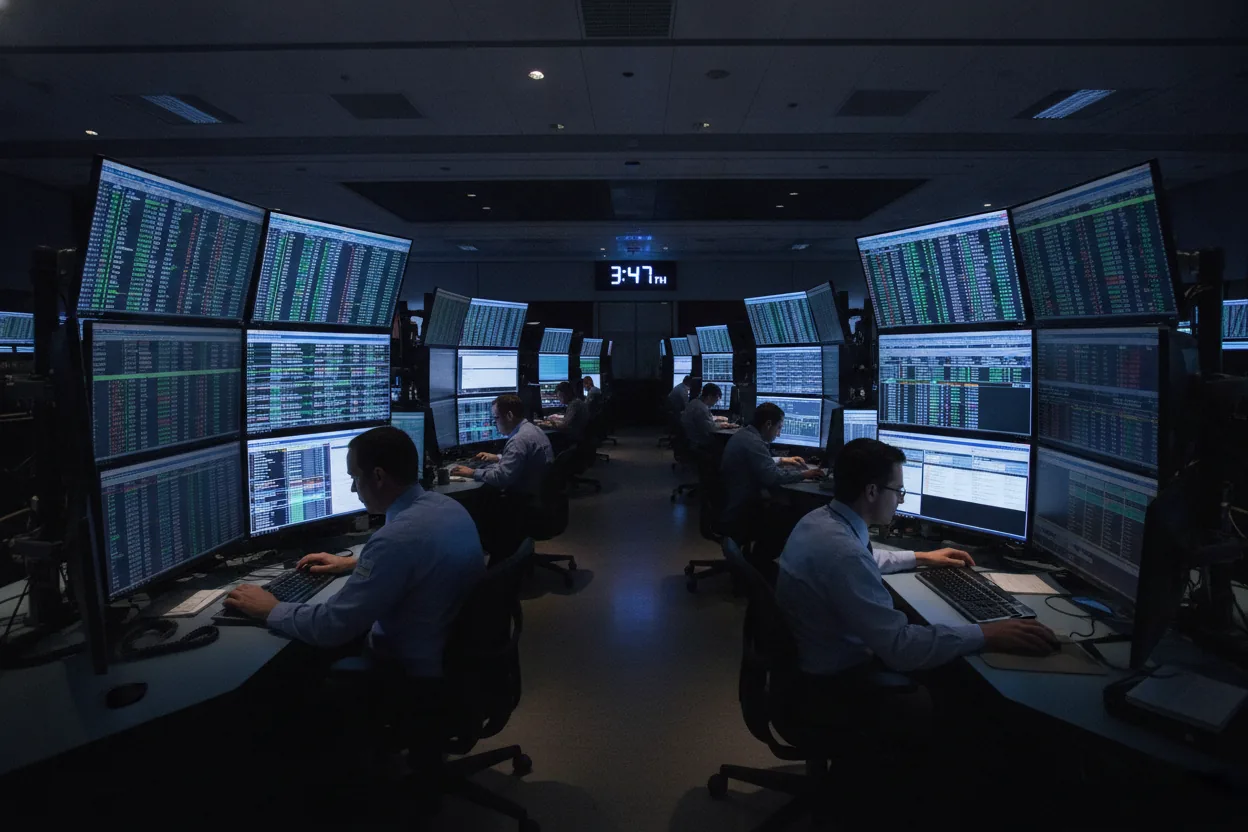
Expiration day isn't a calm wind-down. It's the point of maximum operational stress for the exact firms retail traders assume are just quietly matching orders in the background.
Who Actually Absorbs the Other Side of the Trade
Hedging Risk Intensity as Expiration Approaches
Relative risk index for market makers as an at the money option nears expiration
10
3 Weeks Left
25
3 Days Left
55
3 Hours Left
100
Final Hour
Accelerating gamma and collapsing theta compress most of an option's hedging risk into the final hour before expiration, forcing continuous rehedging by market makers.
Source: Conceptual illustration based on gamma and theta dynamics described in the article
So who's standing on the other side of all that stress? When a trader buys a call option, someone has to sell it. On listed exchanges, that someone is frequently a designated market maker, not another retail trader. Firms like Citadel Securities, Susquehanna International Group, Optiver, and Jane Street run substantial portions of listed options market making across US exchanges, and their business model runs on collecting the bid-ask spread while managing the risk that comes with taking the other side of thousands of contracts a day.
These firms aren't directional bettors the way a hedge fund with a thesis is. Their edge looks more like insurance underwriting. They quote both sides of a market, capture the spread, then spend the rest of the day neutralizing the resulting exposure through the underlying stock, index futures, or other options. The spread is the reward. The hedging is the cost of collecting it.
What actually makes this work at scale isn't a trader eyeballing every position, it's automated hedging engines that recalculate delta and gamma exposure continuously and fire off offsetting orders into the underlying market without waiting for a human to sign off on each one. A single large options desk can generate an enormous volume of underlying share or futures trades purely as a byproduct of managing option risk, with zero conviction attached about where that stock is actually headed.
- Delta gets recalculated continuously across thousands of positions at once
- Orders route automatically into underlying shares or futures
- Spread capture is the real revenue engine, not correct price prediction
- Risk limits force the hedging regardless of what the desk actually believes about the market
Those four things explain why market making firms rarely need to be right about direction to turn a profit, and why their hedging activity can move markets even when the firm itself has no opinion on the stock at all. Their profit depends on staying structurally indifferent to where the stock goes, which is exactly why their hedging flows end up dictating short-term price behavior for everyone who isn't indifferent.
Why Zero Day Options Changed the Math
That hedging burden used to arrive in predictable waves clustered around monthly expirations. Zero days to expiration contracts, or 0DTE, compressed the whole gamma-and-theta dynamic into a single trading session instead. A monthly option gave market makers weeks to manage rising gamma gradually. A same-day contract crams the entire lifecycle, quiet morning, rising sensitivity, violent afternoon swings, into six or seven hours.
Exchange volume data from recent years shows 0DTE contracts on products like SPX growing from a marginal slice of daily options volume to something close to half, and on some sessions more than half, of total volume traded on that index. Because the precise daily figure shifts constantly, it's more honest to call this an observed pattern than a fixed statistic: same-day contracts went from a side bet to a dominant share of index options activity over roughly three years.
The practical effect: market makers now manage extreme gamma exposure almost daily instead of occasionally around traditional monthly expirations. Hedging flows that used to cluster around the third Friday of each month now show up, in smaller but more frequent doses, on nearly every trading day the market is open.
This isn't a passing fad in options structure. It's a permanent rewiring of market plumbing, one that made the entire market absorb concentrated hedging pressure far more often, and that rewiring benefits the firms whose infrastructure can handle daily gamma spikes instead of monthly ones.
The Pinning Effect Nobody Explains Well
One direct byproduct of that daily gamma exposure is a pattern traders have noticed for years: certain stocks and indexes seem to gravitate toward round-number strike prices right before expiration. Traders call this pinning, and it's a direct consequence of dealer gamma positioning, not coincidence, and not some mystical chart pattern.
When market makers are net long gamma at a particular strike, meaning they benefit from the underlying staying close to that price, their hedging activity dampens movement away from the strike. As the stock rises above it, their hedge requires selling into the rise. As it falls below, their hedge requires buying into the decline. That mechanical, price-insensitive buying and selling creates a gravitational pull toward the strike as expiration approaches.
The reverse happens too. When dealers are net short gamma at a strike, their hedging amplifies movement instead of dampening it, buying into rallies and selling into declines. That's part of why some expiration days produce unusually calm price action while others produce outsized moves that seem disconnected from any actual news.
Analysts now track aggregate dealer gamma exposure, sometimes labeled GEX in market commentary, as a rough proxy for whether hedging flows will suppress or amplify volatility on a given day. Figures published by different data providers vary and should be treated as directional signals rather than precise measurements of dealer books, since no outside party actually sees every market maker's position. Pinning isn't manipulation in the conspiratorial sense. It's a predictable side effect of a hedging system running at scale, and knowing which way dealer gamma leans on a given day tells you more about likely price behavior than most headlines will.
What This Structure Means For Everyone Else
Understanding pinning and dealer gamma only matters if it changes how retail traders see their own place in a system that's grown considerably larger around them. Retail participation in options has grown substantially since 2020, with brokers reporting rising volumes in single-stock and index options among individual accounts. Most of that growth concentrated in short-dated, high-gamma contracts, exactly the products generating the most volatile hedging flows on the other side of the trade.
There's a structural asymmetry worth naming plainly. A retail trader buying a same-day call option is making a directional bet with limited capital at risk. The market maker on the other side is running a hedged book across thousands of similar positions, with infrastructure built specifically to manage the exact risk that single trade represents. One side is exposed to randomness. The other is exposed to aggregate probability, smoothed across volume, which is a very different game even when both sides are technically trading the same contract.
None of this makes retail options trading pointless, and it doesn't mean the system is rigged in any legal sense. Exchanges, clearinghouses, and market makers operate within regulatory frameworks that require quoting obligations and capital requirements. What it does mean is that the liquidity retail traders enjoy, tight spreads, instant fills, deep order books, comes directly from a hedging apparatus whose interests aren't aligned with any individual position, long or short.
That's the answer to why the last hour before expiration feels calm to everyone except the desks whose job is to keep it that way: the calm is manufactured, not default. It's the visible surface of a relentless, high-speed hedging system running underneath, one that absorbs the violent gamma spikes described earlier so retail order flow never has to feel them directly. The real question now isn't whether this structure will change, since 0DTE volume shows no sign of slowing down, it's whether the next leg of growth in same-day options pushes dealer hedging flows into a size where they start meaningfully shaping the close of major indexes on an ordinary Tuesday, not just on the days everyone already expects fireworks.
This article is for informational and educational purposes only and does not constitute financial, investment, or legal advice. The views expressed are analytical observations and should not be relied upon for personal financial decisions. Always consult a qualified financial advisor before making investment decisions.
US Tax Treaties for Expats: How Double Taxation Really Works