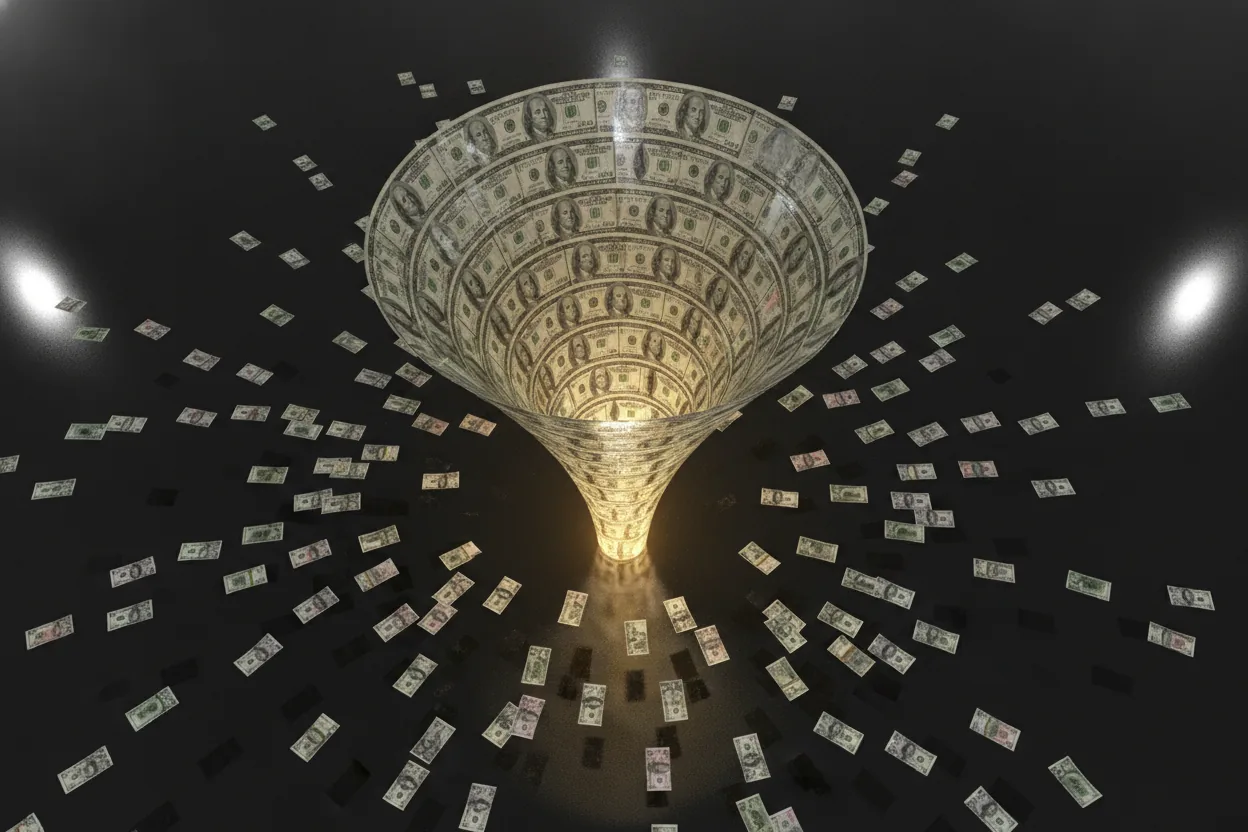
Global total debt has blown past 330 trillion dollars and the dollar has still refused to weaken on schedule. Mainstream economists keep waiting for that combination to break the currency. A seven year old framework built by Brent Johnson says the printing itself is what makes the dollar squeeze everyone else. Someone always profits when the world scrambles for the same scarce currency at once, and it's never the borrower. The real question is who sits on the winning side of that scramble, and why the answer barely changes no matter who runs the Fed or the White House.
The core mechanic is simple to state and brutal in practice. The Federal Reserve floods the world with dollars through quantitative easing and swap lines. Other central banks absorb that liquidity to prop up their own systems. When the flow reverses, everyone scrambles for the same scarce currency at the same time, and the borrower is always the one left holding the bag.
To understand who wins, you have to understand what the dollar actually is in this system. It's not just a currency. It's the collateral layer underneath roughly 14 trillion dollars of offshore dollar denominated debt tracked by the Bank for International Settlements. That debt doesn't disappear when the Fed tightens. It just gets more expensive to service. This is where the theory earns its keep: it explains a mechanism that punishes borrowers regardless of who sits in the White House or the Eccles Building.
What the Dollar Milkshake Theory Actually Describes
The Scale of Dollar Denominated Debt
Key figures behind the squeeze
$330T+
Global total debt
$14T
Offshore dollar denominated debt
$37T
US federal debt, 2025
$20T
US federal debt, 8 years earlier
Source: Bank for International Settlements, US Treasury Department
Johnson's metaphor borrows from the 2007 film There Will Be Blood, where Daniel Plainview boasts about draining his neighbor's oil through a shared reservoir with a straw. The United States, in this analogy, built the world's biggest financial milkshake through decades of quantitative easing, and every other major economy has been drinking from the same cup through dollar denominated borrowing.
The twist is what happens when the straw reverses. Johnson isn't arguing the dollar is fundamentally sound. He's arguing that every other major currency carries a structural flaw: negative real rates in Japan as recently as 2024, persistent capital flight risk tied to China's managed yuan, a European Central Bank still navigating fragmented sovereign bond spreads across Italy, France, and Germany. Weakness elsewhere becomes strength here by default, not by merit.
That's why the theory hinges on rate of change rather than absolute level. A dollar index at 100 says little on its own. A dollar index moving from 95 to 108 within roughly eighteen months, close to the trajectory the DXY traced through parts of 2022, tells you liquidity is being pulled from emerging markets faster than local central banks can replace it. Turkey, Argentina, and Egypt have each lived versions of that squeeze in recent years.
The mechanism rewards whoever controls the reserve currency's supply and punishes whoever borrowed in it without matching revenue. That asymmetry isn't an accident of policy, it's the design, and it explains why the framework keeps outperforming forecasters who treat currency markets as fair contests rather than plumbing with a single valve. The winner here is obvious enough: the issuer of the reserve currency, almost by construction. What's less obvious is why decades of economic theory failed to see this coming.
Triffin's Dilemma and the Currency Squeeze That Never Went Away
Dollar Index Trajectory During the 2022 Squeeze
DXY move from 95 to 108 in about 18 months
95
Start
99
+6 mo
104
+12 mo
108
+18 mo
Rate of change, not absolute level, is what drains liquidity from emerging markets
Source: DXY historical data, as referenced in article
Belgian economist Robert Triffin diagnosed this problem in 1960, decades before anyone coined a milkshake metaphor. His observation: a country whose currency serves as the world's reserve asset must run persistent trade deficits to supply that currency to the rest of the world, and those same deficits eventually undermine confidence in the currency's value.
The United States has run a current account deficit in most years since the early 1980s. Total federal debt crossed 37 trillion dollars in 2025, according to Treasury Department figures, up from roughly 20 trillion just eight years earlier. Under a textbook Triffin framework, that trajectory should have weighed much more heavily on the dollar by now.
It hasn't, at least not the way the textbook predicts, and the milkshake theory offers one explanation why. Dollar demand isn't driven primarily by faith in US fiscal discipline. It's driven by the mechanical need for dollars to service existing dollar debt, trade in dollar priced commodities like oil and copper, and settle a large majority of global FX transactions, a share the Bank for International Settlements has put near 88 percent in recent surveys. You don't need to admire the plumbing to need it.

Triffin was right about the contradiction. He just underestimated how long a system can run on inertia when every alternative carries its own worse contradiction. That gap between theoretical breakdown and practical persistence is where fortunes get made and lost, and it's the gap the milkshake theory has been trading on since 2018. Traders betting on an imminent dollar collapse based on Triffin alone have mostly lost that bet for decades. That's the real lesson here. And it points straight to the next question: who exactly has been collecting on the other side of that bet?
Who Actually Profits When the Dollar Rips Higher
The Dollar Milkshake Mechanism, Step by Step
Source: Based on Brent Johnson's Dollar Milkshake Theory
Dollar strength isn't a neutral weather event. It has counterparties. When the DXY climbed through 2022, US money market funds pulled in over 1 trillion dollars in net inflows in 2023, as investors chased yields north of 5 percent that were simply unavailable in yen, euro, or most emerging market instruments.
Meanwhile, countries holding dollar denominated debt faced a brutal arithmetic problem. Sri Lanka defaulted in 2022. Zambia and Ghana followed. Each case shared a structure: revenue collected in local currency, debt owed in dollars, and a currency mismatch that widened every time the Fed hiked. The dollar's strength was someone else's debt crisis, transmitted through nothing more exotic than an exchange rate.
Domestic winners looked different from international losers. Large US asset managers with dollar cash positions, and multinational firms with pricing power abroad, captured real purchasing power gains. Exporters reliant on a weaker dollar for competitiveness, along with emerging market borrowers, ate the cost.
The winners tend to cluster in a few familiar places: US Treasury money market funds, dollar denominated bondholders in developed markets, multinational firms sitting on dollar cash reserves, and central banks holding large dollar reserve buffers. What connects all four is simple. They hold dollars rather than owe them.
The pattern is consistent enough to call structural rather than coincidental. Dollar strength transfers real wealth from currency mismatched borrowers to dollar based creditors, and the transfer happens through interest rate mechanics that most participants never see until the bill arrives. The winners are institutional and patient. The losers are usually sovereign and stuck. What's changed recently is how fast that transfer gets priced, and that speed is now a market structure story of its own.
The Prediction Markets Layer Nobody Priced Into the Dollar Trade
Structural Weaknesses Across Major Currencies
| Region | Structural Flaw | Consequence |
|---|---|---|
| Japan | Negative real rates through 2024 | Weak yen, capital seeks dollar yield |
| China | Managed yuan, capital flight risk | Persistent outflow pressure |
| Eurozone | Fragmented sovereign spreads (Italy, France, Germany) | No unified fiscal backstop |
| Emerging Markets | Dollar borrowing without matching revenue | Turkey, Argentina, Egypt squeezed |
Source: Article analysis of Japan, China, Eurozone, and emerging markets
Something genuinely new entered this picture in 2026. The CFTC's rulemaking on event contracts, advanced through mid 2026 guidance, opened the door for platforms to list regulated macro prediction markets alongside traditional derivatives. TS Imagine's integration of prediction markets data into trading desk workflows, announced in early August 2026, signals that institutional desks now treat these contracts as a tradable macro signal rather than a novelty.
This matters for a currency theory built in 2018 because prediction markets now offer a live, continuously priced read on Fed policy expectations, sovereign default probability, and currency stress. Those are inputs the milkshake framework depends on but previously had to infer from bond yields and options skew, with a lag.
A trading desk that can see real time probability pricing on, say, a European sovereign credit event no longer waits for a rating agency downgrade to react. That compresses the window between stress emerging and capital reallocating toward dollar assets, which theoretically accelerates milkshake dynamics rather than slowing them.
This is a market structure change, not a footnote. Faster information doesn't reduce the underlying fragility Triffin described. It just means the flight to dollars, when it comes, may arrive in hours rather than weeks, and the desks with the fastest feeds get first pick of the exits. Retail investors, watching headlines instead of live feeds, are structurally last in line. None of this proves the theory is bulletproof, and the honest version of this analysis has to name where it strains.

Where the Dollar Milkshake Theory Actually Breaks Down
No framework survives contact with reality unscathed, and the milkshake theory has real vulnerabilities worth naming plainly. It assumes the Fed can keep rates relatively higher than global peers without triggering a domestic recession severe enough to force cuts that reverse the whole dynamic. That assumption hasn't always held. Rate cuts through late 2024 and into 2025 compressed the dollar index at points, and gold's climb past 2,700 dollars an ounce in that window reflected real hedging demand against dollar debasement, not blind faith in dollar supremacy.
The theory also underweights coordinated efforts to reduce dollar dependence. Central bank gold purchases exceeded 1,000 tonnes annually in 2023 and 2024 according to World Gold Council data, a pace that continued into 2025, with the People's Bank of China and other emerging market central banks diversifying reserves deliberately. That's not proof the dollar collapses. It's proof the appetite for alternatives is real, even if the alternatives remain imperfect.
BRICS settlement mechanisms and bilateral currency swap lines between China and dozens of trading partners represent slow, structural erosion rather than sudden displacement. The dollar's share of global reserves has drifted from roughly 71 percent in 1999 to around 58 percent in IMF COFER data by 2025. That's decline. Not collapse.
Every structural critique of the milkshake theory is valid, and none of them, so far, has produced a viable substitute reserve asset at scale. Erosion and collapse are different processes with very different timelines, and conflating them is the most common mistake made by people trading this narrative. It's also what separates Johnson's framework from the dollar collapse calls that keep failing to materialize. The critics aren't wrong about the trend. They're early, possibly by decades. That distinction between erosion and collapse is really the whole story, and it's worth spelling out what it means for anyone without a Bloomberg terminal.
What the Currency Squeeze Means for Anyone Watching From Outside a Trading Desk
The uncomfortable truth buried inside this whole framework is that dollar strength and dollar weakness both redistribute wealth. They just redistribute it to different people. A stronger dollar rewards savers holding dollar assets and punishes emerging market borrowers. A weaker dollar does roughly the reverse: rewarding US exporters and emerging market debtors while eroding the purchasing power of anyone holding dollar cash.
There's no version of this cycle where the system is neutral, and there's no version where the average retail participant sees the mechanism coming before institutional desks are already positioned around it. TS Imagine's own move into prediction markets and fixed income electronic trading integration this year is evidence that the infrastructure for reacting faster is being built for institutions first, with retail access a distant second, if it arrives at all.
What happens next depends less on any single Fed decision and more on whether the accumulating pressure among gold buying central banks, BRICS settlement experiments, and persistent US fiscal deficits reaches a threshold where the rate of change in the dollar turns disorderly instead of gradual. Nobody, including Johnson himself, claims to know exactly where that threshold sits.
So the scramble this piece opened with has a clear answer: the winners are whoever holds dollars rather than owes them, and that's held true since 2018 regardless of who occupies the Fed or the White House. What matters is the rate of change, not the headline level. Every time it moves, someone is on the winning side of the straw and someone else is watching their local currency debt get more expensive by the hour. The people who understand the plumbing get paid. The people who wait for headlines pay for it.
This article is for informational and educational purposes only and does not constitute financial, investment, or legal advice. The views expressed are analytical observations and should not be relied upon for personal financial decisions. Always consult a qualified financial advisor before making investment decisions.