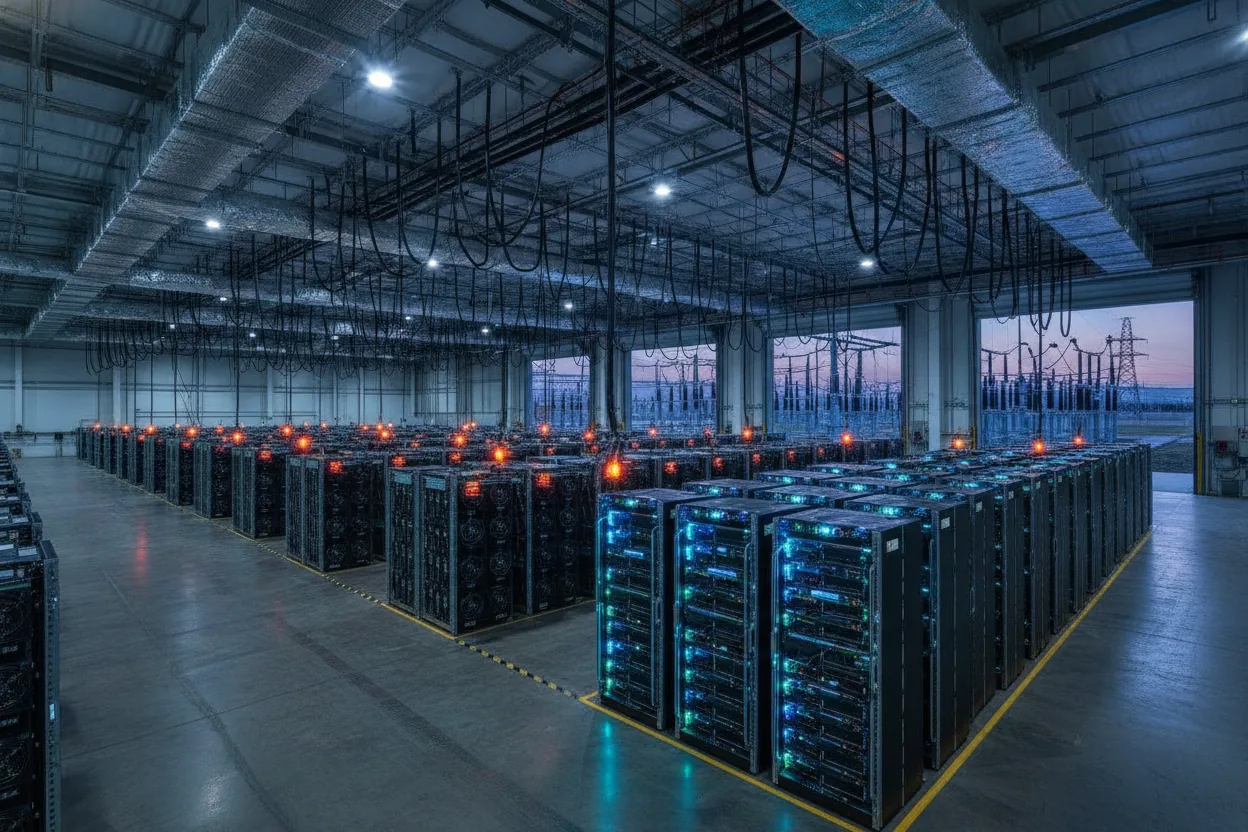
Bitcoin mining difficulty just fell 19.1% from its all time high, only the second time in the network's history it has dropped below where it stood a year earlier. Retail commentary reads this as miners capitulating in fear. The real move is capital fleeing to whoever can lease the same power contracts to AI hyperscalers instead of running ASICs. That distinction decides who profits from this reset and who gets mechanically squeezed out of it. So when Bitcoin mining and AI infrastructure start bidding for the same megawatts, who actually wins?
The headline story is simple: mining got unprofitable, miners turned off machines, the network recalibrated. The real story is about capital allocation, and who gets to decide where computing power flows when two industries, Bitcoin mining and AI infrastructure, start bidding for the same electricity, the same chips, and increasingly the same balance sheets.
My take: this shift benefits large, diversified mining operators with access to cheap power contracts and AI hosting deals far more than it benefits retail holders hoping difficulty drops translate into a friendlier network. It doesn't work that way, and the mechanics explain why.
Why Bitcoin Mining Difficulty Fell and What It Measures
The Difficulty Drop by the Numbers
Source: Source: Article data, Bitcoin network statistics 2026
Mining difficulty isn't a sentiment indicator. It's a mechanical adjustment, recalculated every 2,016 blocks, roughly every two weeks, with one job: keep block production at close to 10 minutes regardless of how much total computing power is pointed at the network. More miners join, hashrate rises, difficulty climbs to slow them back down. Miners shut off machines, difficulty falls to speed things back up. No committee vote, no discretionary call from a central bank equivalent. Just code responding to hardware.
What triggered the current 19.1% retreat isn't a single event but a squeeze. Hashprice, the standard metric for expected miner revenue per petahash per day, dropped to $27.66 in late June, within a cent of February's low. It's since recovered to $31.70, but that recovery looks thin against what miners were earning during 2024's bull run. When hashprice sits this low for this long, marginal miners, the ones running older ASICs on expensive power contracts, can't cover costs. They power down. Difficulty falls in response.
Three forces are doing most of the work here. Weak mining economics from compressed hashprice is the obvious one. Capital reallocation toward AI data center buildouts is the less obvious, more important one. And reduced operating capacity in major mining regions is compounding both.
A miner sitting on a facility in Texas or Kazakhstan isn't just watching Bitcoin's price. They're watching what a hyperscaler like Microsoft or an AI cloud provider would pay to lease that same power capacity and that same physical footprint for GPU racks instead of ASICs. When that number beats mining revenue, and lately it often has, the facility doesn't go dark. It gets repurposed.
Verdict: difficulty dropping isn't the network getting weaker. It's the network's most expensive, least efficient hashrate exiting first, which mechanically favors whoever already owns the cheapest power and the newest machines, not the retail investor hoping this signals a network in distress. That repurposing dynamic is worth examining directly, because it's now reshaping miner balance sheets at the structural level.
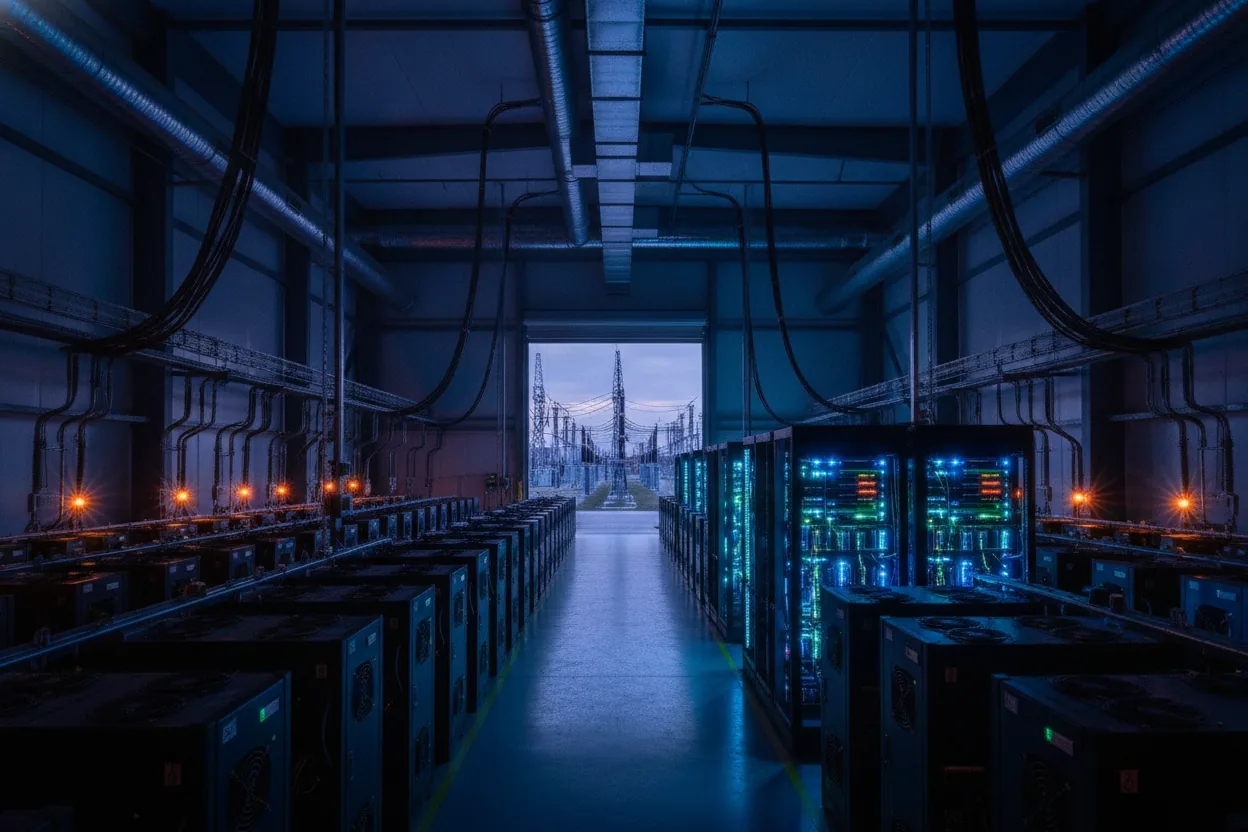
The AI Pivot Is Rewiring Bitcoin Miner Balance Sheets
How a Mining Facility Gets Repurposed for AI
Source: Source: Article analysis of miner capital allocation, 2025 to 2026
This part of the story barely existed three years ago. Publicly traded miners like Core Scientific, Cipher Mining, and Hut 8 have spent 2025 and 2026 converting portions of their fleet capacity, or announcing intentions to, toward AI hosting and high performance computing contracts. Core Scientific in particular has leaned hard into hosting deals tied to AI compute demand, treating its power infrastructure as the actual asset and Bitcoin mining as one possible use of that infrastructure, not the only one.
Why would a Bitcoin miner do this? Because the thing miners actually own, once you strip away the marketing, isn't hashrate. It's power contracts, land, cooling infrastructure, and grid interconnection agreements, often locked in years ago at rates that look extraordinarily cheap next to what AI companies are currently willing to pay for the same megawatts. A miner running that facility for Bitcoin earns whatever hashprice allows, currently hovering near $31.70 per petahash per day. The same facility leased to an AI compute buyer generates contracted, often multi year revenue at rates mining hasn't matched since the difficulty highs of late 2025.
This isn't a uniform trend. Smaller miners without the balance sheet to negotiate hosting contracts, or without facilities suited to GPU density and cooling requirements, don't have this option. They're stuck riding hashprice up and down, which is precisely why the difficulty drop hit unevenly. Large diversified operators trimmed selectively. Marginal operators without a pivot option shut down entirely.
Over the next two years, expect consolidation among miners with hosting capabilities, exits among undercapitalized single purpose mining operations, and rising correlation between miner stock prices and AI infrastructure demand rather than Bitcoin's price alone.
That last one deserves attention. A mining stock's valuation increasingly depends less on Bitcoin's price and more on whether the company signed an AI hosting deal. That's a structural change in what these equities even represent to investors pricing them on a terminal.
Verdict: the AI pivot is quietly transferring the most valuable Bitcoin mining infrastructure into a hybrid asset class, and the winners are the operators who built optionality into their power contracts years before anyone was pricing AI demand into mining valuations. That consolidation raises a broader question for anyone who doesn't operate a facility at all: what does this actually mean for the market watching from the outside?
What Falling Mining Difficulty Means for the Rest of the Market
Who Wins the Difficulty Reset: Two Different Outcomes
| Dimension | Retail Reading | Structural Reality |
|---|---|---|
| Cause | Miner fear and capitulation | Capital reallocated to AI leases |
| Who exits | Miners in general | Least efficient, highest cost hashrate only |
| Network effect | Signals network in distress | Mechanical rebalancing to 10 min blocks |
| Who benefits | Retail holders, broader network | Diversified operators with cheap power and AI deals |
| Example | N/A | Core Scientific, Cipher Mining, Hut 8 |
Source: Source: Article analysis, structural interpretation of difficulty mechanics
Here's where the narrative usually goes wrong. Retail commentary frames a falling difficulty as bearish for Bitcoin, evidence of network weakness, miners capitulating in fear. None of that is quite accurate. Difficulty is a lagging, mechanical response to profitability, not a forward looking signal about Bitcoin's price or adoption. It tells you what already happened to marginal miner economics over the past two weeks. It doesn't tell you what happens next.
What it does tell you, reliably, is something about market structure. When difficulty drops while hashprice recovers, as it has, climbing from $27.66 to $31.70, that combination usually means the network found a temporary equilibrium: enough unprofitable hashrate exited that remaining miners are earning more per unit of work. This is the network doing exactly what it was designed to do. Bitcoin's protocol doesn't care whether miners are happy. It cares whether blocks keep arriving every 10 minutes. Everything else, including miner profitability, is a side effect the protocol tolerates but never guarantees.
For a reader holding Bitcoin rather than mining it, the practical relevance is indirect but real. Sustained miner distress has historically coincided with periods where distressed miners sell held Bitcoin reserves to cover operating costs, adding sell pressure independent of broader market sentiment. Whether that dynamic is materially at play right now is hard to verify without direct miner treasury disclosures, so treat it as an observed historical tendency rather than a confirmed current driver. What's verifiable is the difficulty and hashprice data itself, consistent with miners diversifying revenue rather than relying solely on block rewards and transaction fees.
Here's the deeper question worth sitting with: if the largest, best capitalized miners increasingly treat Bitcoin mining as one revenue stream among several, does that make the network more resilient, since operators can weather price downturns by leaning on AI hosting income? Or does it just concentrate hashrate distribution among fewer, larger players who can afford that optionality in the first place?
Verdict: falling difficulty is neither bullish nor bearish in isolation. It's a redistribution event, quietly consolidating network security into the hands of operators sophisticated enough to hedge Bitcoin exposure with AI infrastructure revenue, and that consolidation matters more for Bitcoin's long term decentralization than any single price chart.
So who actually wins this reset? Not the retail holder reading difficulty drops as a sign of distress. Not the undercapitalized miner with no hosting contract to fall back on. The winners are the operators who quietly turned cheap power contracts into optionality years before AI demand made those same megawatts valuable twice over. Difficulty will adjust again in two weeks, and then again after that, indifferent to whichever narrative currently dominates crypto commentary. The more useful question for anyone watching this space isn't whether difficulty rises or falls next cycle. It's which miners still have a Bitcoin only business model left standing when it does.
This article is for informational and educational purposes only and does not constitute financial, investment, or legal advice. The views expressed are analytical observations and should not be relied upon for personal financial decisions. Always consult a qualified financial advisor before making investment decisions.